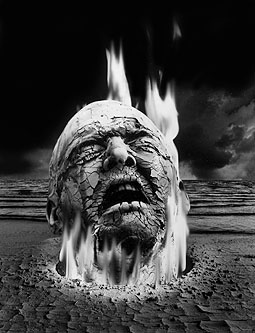
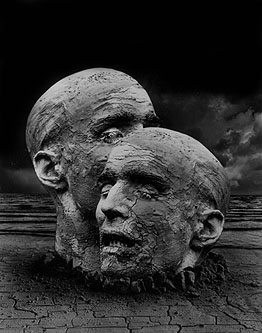
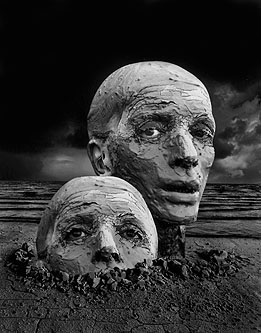
Oedipus the King has many images of blindness, both physical and blindness of the mind. The characters surrounding these images are Oedipus and Tiresias the prophet. When the play begins Oedipus has vision and Tiresias cannot see, but by the end of the play, it is clear who can really see and who is blind. [ Themes -- our blindness today ]
Sophocles' Oedipus Tyrannus: A Map of the Soul -- Aristotle describes Oedipus Tyrannus as "amazing": here there are no villains, and the only mistake is caused by the limits of human understanding...
Sight, Sound, and Sensation in the Oedipus Tragedy: The whole of the Oedipus tragedy has then the underlying imagery of blindness, deafness, and general sensory deficiency; much of this seems to be caused by Oedipus' own refusal to acknowledge the ever-encroaching truth, but it can also be credited to the overwhelming importance of sight and sound to the reception of the tragedy by the characters themselves and by the audience. The literary devices used by Sophocles to enhance this reliance upon physical perception include the ever-present synesthesia, or mixing of the senses, as well as the use of music and poetical passages, all of which underscore once again the necessity of sensation and feeling to the explication of human emotions.
Captions (reason) for images -- many are not included (process -- preproduction); steps in (director) concept development.
Mythology ch. 10 -- Monsters. Giants. Sphinx. Pegasus and the Chimaera. Centaurs. Griffin. Pygmies
Thomas Bulfinch
THE SPHINX
... Shortly after this event the city of Thebes was afflicted with a
monster which infested the high-road. It was called the Sphinx.
It had the body of a lion, and the upper part of a woman. It lay
crouched on the top of a rock, and stopped all travellers who
came that way, proposing to them a riddle, with the condition
that those who could solve it should pass safe, but those who
failed should be killed. Not one had yet succeeded in solving
it, and all had been slain. OEdipus was not daunted by these
alarming accounts, but boldly advanced to the trial. The Sphinx
asked him, "What animal is that which in the morning goes on four
feet, at noon on two, and in the evening upon three?" OEdipus
replied, "Man, who in childhood creeps on hands and knees, in
manhood walks erect, and in old age with the aid of a staff."
The Sphinx was so mortified at the solving of her riddle that she
cast herself down from the rock and perished.
[ presence of the Sphinx on stage -- screen? ]
Trilogy full text online ***
Hypertext Meanings and Commentaries
from the Encyclopedia of the Self
by Mark Zimmerman
Sophocles' Antigone
Sophocles' Oedipus the King *
Sophocles' Oedipus at Colonus
* Translation by F. Storr, BA - Formerly Scholar of Trinity College, Cambridge
From the Loeb Library Edition
Originally published by Harvard University Press, Cambridge, MA and William Heinemann Ltd, London
First published in 1912
(Str. 1) Sweet-voiced daughter of Zeus from thy gold-paved Pythian shrine Wafted to Thebes divine, What dost thou bring me? My soul is racked and shivers with fear.
(Healer of Delos, hear!) Hast thou some pain unknown before, Or with the circling years renewest a penance of yore? Offspring of golden Hope, thou voice immortal, O tell me.
(Ant. 1) First on Athene I call; O Zeus-born goddess, defend! Goddess and sister, befriend, Artemis, Lady of Thebes, high-throned in the midst of our mart! Lord of the death-winged dart! Your threefold aid I crave From death and ruin our city to save. If in the days of old when we nigh had perished, ye drave From our land the fiery plague, be near us now and defend us!
(Str. 2) Ah me, what countless woes are mine! All our host is in decline; Weaponless my spirit lies. Earth her gracious fruits denies; Women wail in barren throes; Life on life downstriken goes, Swifter than the wind bird's flight, Swifter than the Fire-God's might, To the westering shores of Night.
(Ant. 2) Wasted thus by death on death All our city perisheth. Corpses spread infection round; None to tend or mourn is found. Wailing on the altar stair Wives and grandams rend the air-- Long-drawn moans and piercing cries Blent with prayers and litanies. Golden child of Zeus, O hear Let thine angel face appear!
(Str. 3) And grant that Ares whose hot breath I feel, Though without targe or steel He stalks, whose voice is as the battle shout, May turn in sudden rout, To the unharbored Thracian waters sped, Or Amphitrite's bed. For what night leaves undone, Smit by the morrow's sun Perisheth. Father Zeus, whose hand Doth wield the lightning brand, Slay him beneath thy levin bold, we pray, Slay him, O slay!
(Ant. 3) O that thine arrows too, Lycean King, From that taut bow's gold string, Might fly abroad, the champions of our rights; Yea, and the flashing lights Of Artemis, wherewith the huntress sweeps Across the Lycian steeps. Thee too I call with golden-snooded hair, Whose name our land doth bear, Bacchus to whom thy Maenads Evoe shout; Come with thy bright torch, rout, Blithe god whom we adore, The god whom gods abhor.
From the Bible to the popular song,
There's one theme that we find right along;
Of all ideals they hail as good,
The most sublime is motherhood.

There was a man though, who it seems,
Once carried this ideal to extremes.
He loved his mother and she loved him,
And yet his story is rather grim.

There once lived a man named Oedipus Rex,
You may have heard about his odd complex.
His name appears in Freud's index
'Cause he loved his mother.

His rivals used to say quite a bit
That as a monarch he was most unfit.
But still in all they had to admit
That he loved his mother.

Yes, he loved his mother like no other,
His daughter was his sister and his son was his brother.
One thing on which you can depend is,
He sure knew who a boy's best friend is.

When he found what he had done,
He tore his eyes out, one by one.
A tragic end to a loyal son
Who loved his mother.

So be sweet and kind to mother,
Now and then have a chat.
Buy her candy or some flowers,
Or a brand new hat.
But maybe you had better let it go at that.

Or you may find yourself with a quite complex complex
And you may end up like Oedipus.
I'd rather marry a duck-billed platypus
Than end up like old Oedipus Rex.
http://members.aol.com/quentncree/lehrer/oedipus.htm -- Tom Lehrer
Ethical Aporias of the Philosophy of Desire: The Case of Anti-Oedipus
... Foucault went on to say that in his judgment Anti-Oedipus was a critique of the most insidious dimension of fascism: the way in which men and women willingly enslave themselves to fascist modes of being.